
“I did some research and found that there are some actual cyborgs walking around on Earth right now,” actor Babou Ceesay said of preparing to play the cyborg Morrow on FX’s “Alien: Earth.” The show is set in 2120, but Ceesay pointed out that there are some people right now, in real life, who have embraced cybernetic enhancements to transcend the limitations of humanity.
“The one that stuck with me was Neil Harbisson,” Ceesay said. “He’s a colorblind artist and he’s got a thing attached to the base of his collar — comes out the front — and through vibration and sound, he’s able to tell [how] the color of things [is] useful for an artist.”
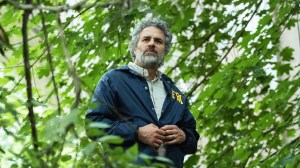
Tying Harbisson’s so-called “eyeborg” into his “Alien: Earth” character, who is turned into a cyborg after being rescued from the streets by the mysterious head of the Weyland-Yutani Corporation, Ceesay added, “He made a statement about feeling more than human, and I used that as an entry point. I thought, ‘OK, what does it feel like to feel you’re more than human?’”
With that starting point in mind, creating Morrow then became a team effort involving Ceesay and multiple craftspeople, who joined IndieWire for a Pass the Remote panel, in partnership with Disney, about making this highly unique character. Morrow’s cyborg arm can transform into a welder, a blade, and other tools — effects that required a true team effort to realize. For our discussion, which you can watch above, Ceesay was joined by executive producer and multi-episode director Dana Gonzales, who also served as DP of Episode 1, producer and editor Regis Kimble, visual effects supervisor Jonathan Rothbart, and lead prosthetics supervisor and designer Steve Painter. Each were essential collaborators in the making of Morrow.
Morrow’s storyline comes to a head in Episode 5 titled “In Space, No One…” — which, of course, is a phrase any cinephile could complete. It’s the series’ version of an “Alien” movie, featuring the characters trapped on a spaceship with a xenomorph running loose. More importantly, it’s where we learn more about Morrow and his motivations, including that he signed up for the 65-year mission to provide for his daughter and that he does the horrible things he does, like sacrificing his crew members to protect a valuable alien species, out of a strange loyalty to his boss and rescuer, Ms. Yutani (Sandra Yi Sencindiver). We also learn that his daughter died suddenly in a fire when she was 19, leaving Morrow without a reason to get home.
“It’s not grand horror to start, but as you’re entering in and meeting all of these people [on the spaceship] and rolling through all of their lives and what their goals are on this particular mission, the creature then adds to the pace,” Kimble said of his editing strategy for Episode 5. “It’s a much more muscular cutting style than the rest of the series by [showrunner] Noah Hawley’s design.
“It’s one of those things where not only is the picture becoming faster and faster paced, the sound is as well, and everybody’s talking on top of each other,” he added. “But at first you’re slowed down with [elongated takes] until you finally get to a place where even the sound is starting to glide into a silent world — so that you have the impact of this horrific creature come flying at you in a way that you weren’t necessarily anticipating.”
Morrow does horrible things to sabotage his crew members as the xenomorph is crawling around the ship, but Kimble said that he still doesn’t see the character as an archetypal villain — the kind that might have a twisted mustache. “It’s interesting because I always found Morrow to be highly motivated,” he said. “It was always born out of need. He had this moral obligation to fulfill a contract where someone plucked him out of the streets and changed his life.”
The biggest moment, shown in Episode 1 in a cold open to the entire series as well, is when Morrow unleashes his cyborg arm, turning his hand into a welder, to seal himself in — dooming one of his crewmembers to certain death at the xenomorph’s fangs.
“As we were designing the look of the arm in [post-production], what was really important to me was that whatever design we did didn’t take away from the character itself,” Rothbart said. “And I kept on thinking to myself, ‘It can’t be Terminator, it can’t be Terminator, it can’t be Terminator.’ So really trying to fight that urge to show off this metallic arm and make it some centerpiece of who he is, and instead have it more in the background and just woven into the tapestry of his character.”
He added, “I thought of something like ‘Mad Max: Fury Road,’ where she has a [prosthetic] arm the whole time, and what was important was that you got so into the character that you never really focused on the arm at all. It was really my goal that nobody sat there and ever said, ‘Oh, the CG arm is cool.’”
Making the arm an extension of Morrow as a character, rather than “an effect,” speaks to the grounded approach of “Alien: Earth” overall. To increase the naturalism of Morrow having a cybernetic arm, Painter had Ceesay wear an actual prosthetic arm over his own arm to simulate the way Morrow would move with it. “It was weeks and weeks and weeks of work,” Painter said of designing, building, and fitting the arm just so to Ceesay.
“We tried to avoid the ‘green-sock element’ and have a visual aid for Babou and for Noah and for Dana and for everyone on set,” Painter said, referring to having the cyborg arm on Morrow as a practical effect that would then be enhanced with VFX. “That was my biggest challenge: producing a three-dimensional version of the concept to help everybody on set.”
When the prosthetic was finished, Gonzales said, “We didn’t have to hide from it” from then on. “Once he put that on, it wasn’t like, ‘Hey, Babou, make sure we don’t see… Don’t use that hand,’ or you know what I mean?” he said. “Because that’s what you do sometimes [when] you don’t want to see the green, or you’re trying to save money or whatever.”
For Gonzales, it was really a matter of honoring the original “Alien” film from 1979 — of creating the feeling of seeing that movie for the first time for a whole new swath of viewers. And both that film’s director, Ridley Scott, and star, Sigourney Weaver, have expressed their love for what “Alien: Earth” has accomplished.
“To see Sigourney and Ridley just say, ‘This is so good. It’s so right, and it expands the universe,’” meant so much, Gonzales said. “Here’s the guy who created it, and he loves it. Here’s the woman who played the initial protagonist and brought it to life, and she loves it.”
Watch the full conversation in the video above.
This conversation was presented in partnership with Disney.